Since July 1, 2026, a temporary program called the Medicare GLP-1 Bridge has covered three GLP-1 medicines for weight management, for a $50 copay a month. It runs until December 31, 2027, and it's only for people with Medicare drug coverage (Part D) who meet its rules. That's why Monday, December 7 matters: it's the last day of Open Enrollment, the yearly window to join or switch a Medicare drug plan for 2027.
This guide sticks to what CMS, which runs Medicare, and Medicare.gov say. Whether a GLP-1 suits you is a question for your prescriber, and which plan to pick is one Medicare or a counselor can help with; this guide answers neither.
What the Bridge covers
The Bridge is a CMS demonstration that runs "outside of the Medicare Part D benefit's coverage and payment flow," so your drug plan has no role in it. The $50 copay and a $245 monthly price to Medicare were announced by the White House on November 6, 2025, in agreements with Eli Lilly and Novo Nordisk. When prescribed for weight management, the Bridge covers:
- semaglutide (Wegovy®), the injection or the tablets;
- orforglipron (Foundayo™) tablets;
- tirzepatide (Zepbound®) in the KwikPen only. Medicare.gov says the single-dose pen and the vials aren't covered.
We checked CMS's list of covered packs against the US labels, and every strength is on it, including the 7.2 mg Wegovy pen. Each fill is one month's supply, 28 or 30 days. CMS says there are no 60-day or 90-day fills, and KwikPen needles aren't covered.
Who qualifies
Your drug coverage has to be a standalone Medicare drug plan, a Medicare Advantage plan with drug coverage (HMO, HMO-POS or PPO), a Special Needs Plan, an employer or union group plan, or the LI NET program, Medicare.gov says. Private fee-for-service plans, cost plans and PACE don't count on their own.
You must also be 18 or older and, when you started GLP-1 treatment, have had:
- a BMI of 35 or more; or
- a BMI of 30 or more with heart failure with preserved ejection fraction, uncontrolled high blood pressure, or chronic kidney disease at stage 3a or higher; or
- a BMI of 27 or more with prediabetes, a past heart attack or stroke, or peripheral artery disease with symptoms.
So someone already on a GLP-1 is judged by their BMI when they began. Your prescriber also has to certify that you're using the medicine as part of a lifestyle program focused on diet and exercise.
You aren't eligible if you have type 2 diabetes, moderate-to-severe sleep apnea or fatty liver disease, or if your Medicare drug plan pays for a GLP-1 for you. Medicare.gov says your plan may cover it instead.
How it works
Your prescriber sends the prescription to your pharmacy, which sends the claim to the Bridge and may ask for your Medicare Number. If you're eligible, the pharmacy asks your prescriber for a prior authorization. CMS says the decision follows within 72 hours of the prescriber sending it, and it's mailed to you. You then pay $50 for each month's supply.
An approval lasts through December 31, 2027, refills and dose changes included, unless you change to a different GLP-1, which needs a new one. There's no appeals process, though a prescriber can resubmit. 1-800-MEDICARE (1-800-633-4227) can tell you where a request stands.
What the $50 doesn't do
Medicare.gov says the $50 doesn't count toward your plan's deductible or yearly out-of-pocket limit and won't appear on your Part D Explanation of Benefits. Extra Help can't lower it, and the Medicare Prescription Payment Plan can't spread it over months. CMS adds that coupons and discount programs can't be applied, and that pharmacies can apply an override for a vacation fill, but there are none for lost or stolen medicine.
Why December 7 matters
The Bridge has no December 7 deadline of its own. Open Enrollment does: from October 15 to December 7 you can join, switch or drop a Medicare drug plan or Medicare Advantage plan, and the change starts January 1. CMS's rules tie the two together:
- No drug coverage, no Bridge. Medicare.gov tells people without it that they may become eligible once they have it.
- It's the type of plan that counts. CMS tells plans not to advertise the Bridge or suggest it comes with a particular plan. But if someone approved for it moves to a plan type that doesn't count, CMS says their next Bridge refill is rejected.
- A GLP-1 from your plan ends it. If someone approved for the Bridge later fills a GLP-1 through their Part D plan, CMS says Bridge refills are rejected too. It hasn't said how far back it will look for such fills in 2027.
1-800-MEDICARE and your State Health Insurance Assistance Program (SHIP) can look at your own case. Medicare.gov says SHIPs "aren't connected to any insurance company or health plan," and their counseling costs nothing. Find yours at shiphelp.org.
After 2027
When CMS extended the Bridge in April, it delayed BALANCE in Part D for 2027 "pending further evaluation and data collection." BALANCE is CMS's model for negotiating GLP-1 prices with makers on behalf of drug plans. CMS speaks of the "potential implementation of BALANCE in Part D" and hasn't said what follows the Bridge.
Questions to take to your plan, pharmacy or prescriber
0 of 6 ready
Keeping a record
The Bridge goes by your BMI when treatment began, and its $50 stays off your plan's paperwork, so your own record matters more than usual. It helps to note:
- the day you started your GLP-1, and your weight then;
- the date of the approval letter, and the medicine it names;
- each fill: the day, the strength and what you paid.
Our guide to tracking pen supply covers the counting.
Hushweek and the Medicare GLP-1 Bridge
Hushweek doesn't check coverage and never looks up prices; it keeps the record. Wegovy, the Zepbound KwikPen and Foundayo all follow their US labels in it. Add each pen, pack or bottle to your supply when you pick it up, with what you paid if you like, and Hushweek counts the doses left from your log and shows the day each one runs out. With Pro, What it costs adds up your prices by month, and a refill reminder can come three days, a week or two weeks before your supply runs out, without naming your medicine.
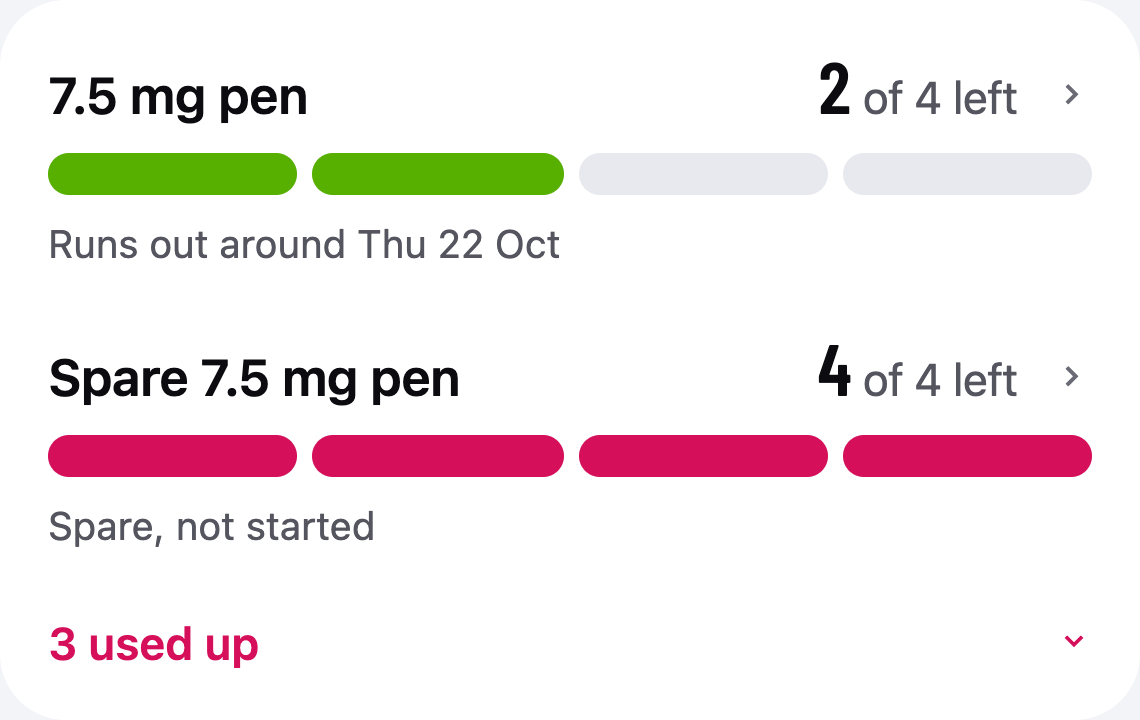
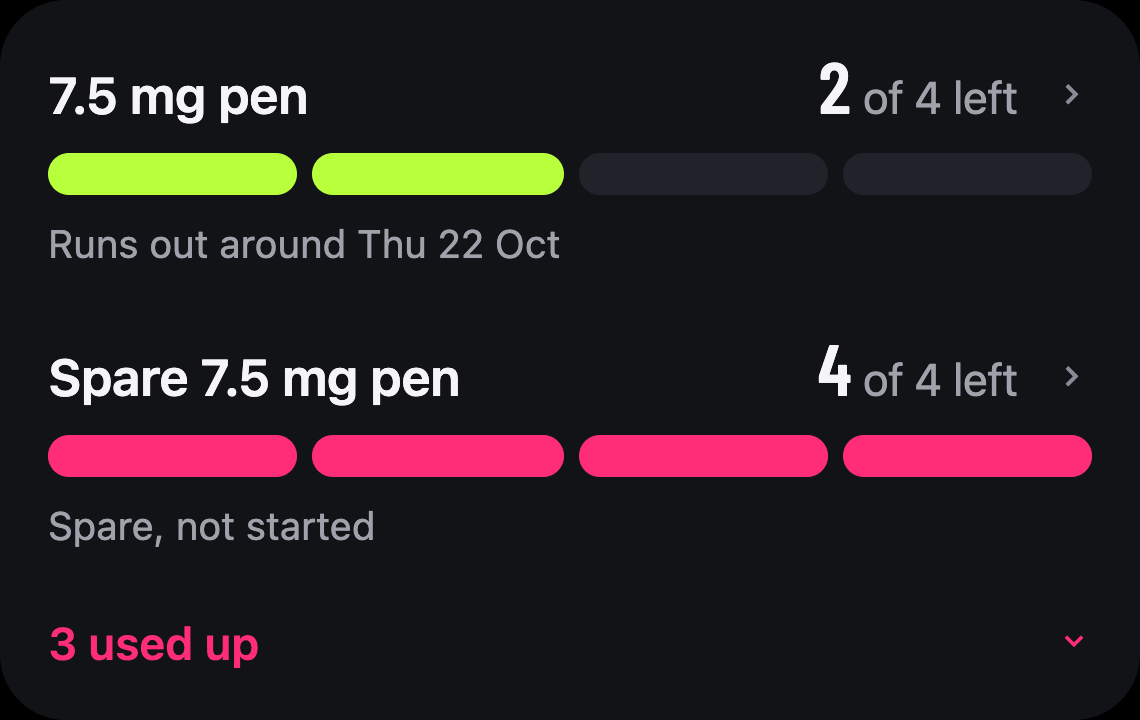
If your medicine changes, which needs a new Bridge approval, You › Medicine and schedule › Switch medicine keeps both in one history. With Pro, the doctor report puts your start date, starting weight and doses in one PDF.
Sources
- Medicare.gov, Weight loss drugs (the Medicare GLP-1 Bridge page)
- Medicare.gov, Medicare GLP-1 Bridge: GLP-1 Drugs for $50 a Month, June 2026
- CMS, Medicare GLP-1 Bridge, updated July 13, 2026
- CMS, Information for Providers, updated August 6, 2026
- CMS, Information for Pharmacies, updated August 17, 2026
- CMS, Information for Part D Plans, updated August 6, 2026
- CMS, Medicare GLP-1 Bridge: Expectations and Frequently Asked Questions for Part D Sponsors, June 10, 2026
- CMS, Status Update on the BRIDGE Demo and BALANCE Model in Part D for CY2027, April 21, 2026
- CMS, BALANCE Model, updated September 29, 2026
- The White House, Fact Sheet: President Donald J. Trump Announces Major Developments in Bringing Most-Favored-Nation Pricing to American Patients, November 6, 2025
- Medicare.gov, Joining a plan
- US prescribing information, section 16, on DailyMed: Wegovy, Zepbound, Foundayo
Questions people ask
What is the Medicare GLP-1 Bridge?
A temporary CMS program that covers Wegovy, Foundayo and the Zepbound KwikPen for weight management at $50 a month, for eligible people with Medicare drug coverage, until December 31, 2027.
Are Zepbound vials covered by the Medicare GLP-1 Bridge?
No. Only the KwikPen is; Medicare.gov says the single-dose pen and the vials aren't covered.
Do I have to change plans by December 7 to use the Bridge?
The Bridge has no December 7 deadline. It does need Medicare drug coverage of a type it counts, and December 7 ends Open Enrollment for 2027.
Does the $50 count toward my Part D out-of-pocket limit?
No, Medicare.gov says, and Extra Help can't lower it.
What happens to the Bridge after 2027?
It ends on December 31, 2027, with its approvals. CMS hasn't said what follows it.
Can I log Bridge fills in Hushweek?
Yes, as supply, with what you paid if you like. Hushweek doesn't check coverage or look up prices.
Keep your week in one quiet place.
Doses, sites, weight, side effects and food in one private app that follows your medicine’s own label. No account needed.
Get Hushweek