Hair in the brush, more in the shower drain, a parting that looks a little wider: hair shedding is one of the most talked-about changes among people on GLP-1 medicines, and one of the more unsettling ones, because it's visible and it touches how you see yourself.
This guide sets out what the US labels report about hair loss, quoted word for word, and what's worth noting if it happens to you, so you can bring a clear picture to your prescriber. It explains the labels; it doesn't diagnose anything or replace medical advice.
What the trials found
Three US labels report hair loss from their clinical trials, with numbers, and each begins the same way: it was associated with weight reduction.
Semaglutide (Wegovy®) injection. Section 6.1 of the US label, "Clinical Trials Experience", says:
"Hair loss adverse reactions in WEGOVY injection-treated patients were associated with weight reduction."
In the label's pool of trials of the 2.4 mg dose, hair loss was reported in 3.3% of people on Wegovy and 1% of people on placebo. In trials of the 7.2 mg dose, it was reported in 5.8% of people on 7.2 mg, 3.3% on 2.4 mg and 1.0% on placebo.
Tirzepatide (Zepbound®). Section 6.1 of its US label says:
"Hair loss adverse reactions in ZEPBOUND-treated patients were associated with weight reduction."
In a pool of two of its trials, the label reports hair loss in 7.1% of women and 0.5% of men on Zepbound, against 1.3% of women and none of the men on placebo. It adds that no one on Zepbound in those trials stopped treatment because of it.
Orforglipron (Foundayo™). Section 6.1 of its US label also links hair loss to weight reduction, and reports it in 7% of women and 0.9% of men on Foundayo, against 3% of women and 0.7% of men on placebo.
Two patterns run through all three. Hair loss was reported more often in women than in men, and it also turned up in people on placebo, who weren't taking the medicine at all.
What the other labels say
The US labels for semaglutide (Ozempic®, Rybelsus®), tirzepatide (Mounjaro®), dulaglutide (Trulicity®) and liraglutide (Victoza®, Saxenda®) list alopecia, the medical word for hair loss, among reactions reported after the medicine went on sale, in section 6.2, "Postmarketing Experience". That section explains what such a list can and can't show. The Ozempic and Mounjaro labels put it like this:
"Because these reactions are reported voluntarily from a population of uncertain size, it is not always possible to reliably estimate their frequency or establish a causal relationship to drug exposure."
In other words, it's on the list because people reported it, not because a trial measured how often it happens.
What the labels don't tell you
The labels report how often hair loss came up and who it came up in. They don't say how long it lasts for any one person, or what to do about it. Hair can change for many reasons besides any medicine, and working out what's behind it is a job for your prescriber, or for a doctor who specialises in hair and skin. What you can bring to that conversation is a good record.
What to note
If you notice shedding, a few details make your record useful:
- When it started. The date you first noticed it, and whether it came on suddenly or gradually.
- How much. A rough scale is enough: a little more than usual, clearly more, or a lot. A note like "a handful after washing" is better than none.
- Where. All over, or in one area, such as the parting, the temples or the crown.
- What else was happening. A dose step, a fast stretch of weight loss, an illness, a stressful few weeks, eating much less than usual, or a new medicine.
- Photos. A photo of your parting or hairline every few weeks, in the same light and from the same angle, shows change far better than memory. Our progress photos guide explains how to take ones you can compare.
Keep the rest of your log going too: weigh-ins, food and your check-ins. Shedding that began a couple of months into a fast drop in weight tells a different story from shedding that began with a new medicine, and only a record that covers both shows which one you're looking at.
Bring it up at your next appointment, and don't wait for one if it's sudden, comes out in patches, or comes with other symptoms that worry you.
How Hushweek does it
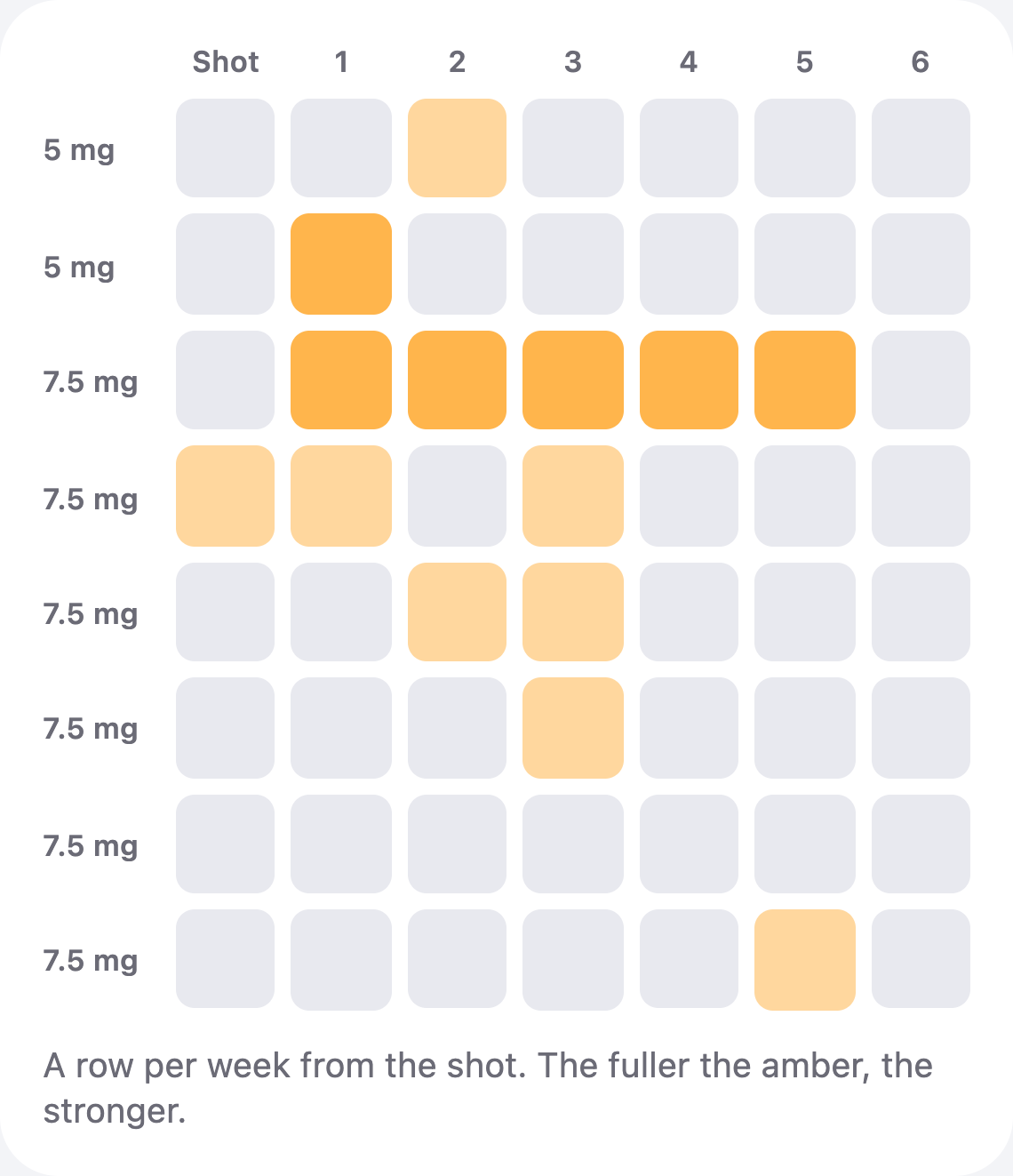
Hair loss is one of the side effects you can log in Hushweek's How are you feeling? sheet, the same one as your daily check-in. A tap marks it mild, and further taps make it moderate or severe. On the Shots tab, the side effects grid lines up each week from your dose, a row a week, so you can see whether anything tends to land on the same days. Logging side effects and the grid are free.
Progress photos stay on your phone; four are free, and Pro adds unlimited photos and a side-by-side comparison. The doctor report lists each side effect with how often you logged it and how strong it was; your first report is free.
Questions people ask
Is hair loss a side effect of GLP-1 medicines?
The US labels for Wegovy, Zepbound and Foundayo report hair loss in their trials and say it was associated with weight reduction. Other GLP-1 labels list it among reactions reported after approval.
Is hair loss more common in women on GLP-1s?
In the trials those labels report, hair loss was reported more often in women than in men, both on the medicine and on placebo.
What should I write down if my hair is shedding?
When it started, how much, where, what else was happening at the time, and a photo of your parting or hairline every few weeks in the same light.
Can I log hair loss in Hushweek?
Yes, for free. Hair loss is one of the side effects in the How are you feeling? sheet, marked mild, moderate or severe.
Keep your week in one quiet place.
Doses, sites, weight, side effects and food in one private app that follows your medicine’s own label. No account needed.
Get Hushweek